Why Your Creative Testing Starts at the Brief, Not the Ad Account
By most practitioner estimates, around 80% of performance work now sits in creative operations rather than media buying. If that ratio is anywhere near right for your team, then the highest-leverage document in your growth stack is not your media plan. It is your creative brief.
After producing 10,000+ ads across DTC, one thing is consistent: most creative testing fails before a single ad goes live. Not because the concepts are wrong or the targeting is off, but because the opening frame, the first line of copy and the creator's energy in the first two seconds get written into a brief once and then forgotten.
Most brands treat testing as something that happens in the ad account. The brands that scale treat it as something that starts at the brief. Here is what changed to make that true, and what to do about it.
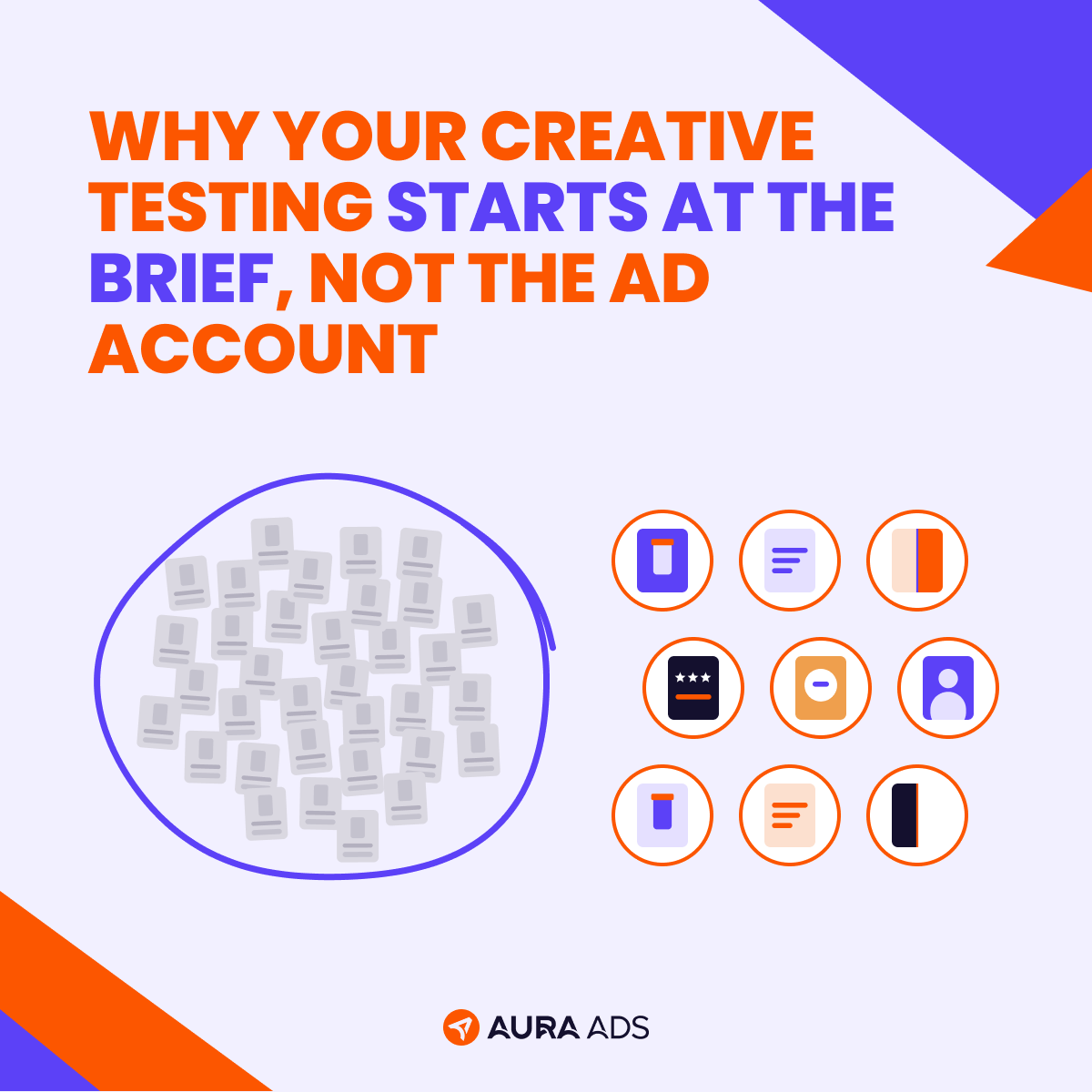
1. Your 50 Ads Might Be 3 Ads
Meta's delivery system now has a retrieval stage that narrows tens of millions of candidate ads down to a shortlist in a few hundred milliseconds, before ranking decides what anyone finally sees. Andromeda, which completed its global rollout in October 2025, is the layer doing that narrowing.
It does not evaluate your ads one at a time. It clusters them by semantic and visual similarity, using computer vision, natural language processing and audio analysis. Ads that look similar, sound similar or address the same person end up grouped together. The industry shorthand for those clusters is Entity IDs, which is an explanatory model rather than an official Meta term, but it describes the behaviour accurately enough to plan against.
If your 50 creatives cluster into three groups, you have effectively uploaded three ads.
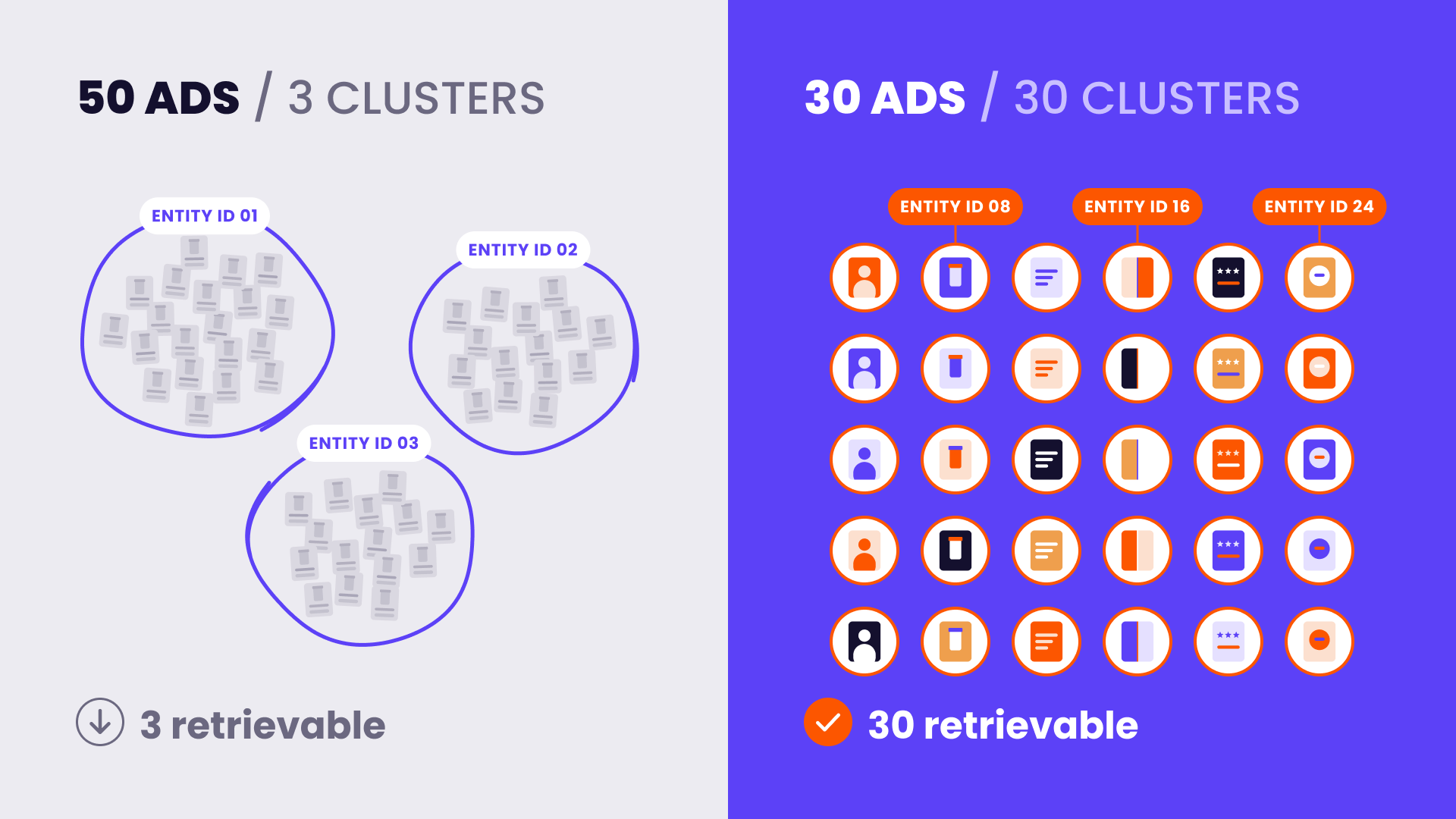
When ads cluster tightly, the system does not retrieve all of them. One representative example serves the same purpose, so the rest are deprioritised. That is a resource decision rather than a penalty, but the effect on your account is identical.
This is why certain variants stopped working. Swap a headline colour, change a background, trim two seconds from the end, and the system reads the same concept. You are not generating new signal.
The cost of that has risen, because fatigue windows have tightened. Observed creative lifespan on Meta before noticeable fatigue currently sits at roughly 14 to 21 days, and considerably shorter on TikTok at 7 to 10, with higher spend pulling both towards the fast end. The window in which a concept can generate signal is narrower than it was, which makes producing one concept ten ways more expensive than it used to be.
So the bottleneck has moved. It used to be production volume. Now it is conceptual originality, and that is determined before anything is shot, designed or uploaded.
2. A Concept Without Variants Is a First Draft You Called Finished
A concept is a starting point rather than a finished ad. The same core idea, say a real customer talking about a specific result, can be realised in dozens of ways: the energy of the opening, whether the creator speaks to camera or is caught mid-action, whether the first words address a doubt, state a result or ask a question.
The distinction that matters is between concept testing and execution testing. Concept testing tells you whether the underlying idea resonates: the narrative, the person it speaks to, the problem it addresses. Execution testing tells you which version of that idea lands hardest. Running one execution per concept collapses the two, so you can never be certain whether a concept failed or an execution did.
That uncertainty compounds. A concept killed on the strength of one weak execution does not just cost you the test; it removes a territory from your roadmap, and nothing in your reporting will tell you it happened.
Research from Nielsen and Nielsen Catalina Solutions, based on a meta-analysis of nearly 500 campaigns, found that 47% of a brand's sales lift from advertising is attributable to creative quality and messaging, against 36% for all media buying and planning factors combined. Finding the best execution of a strong concept matters roughly as much as finding the concept did.
3. The Variants Worth Producing
Hook variants test execution
The hook is the highest-impact creative variable in a video ad. Not the script, not the offer, not the production quality. The opening three seconds.
Take a creator testimonial for a gut health supplement, where the concept is a real customer talking about their digestion improving after 30 days.
Hook A opens with the creator looking into camera: "I did not believe this would work either." Doubt-led, speaking to the sceptic who has tried things before and been disappointed.
Hook B opens with a text card over silent footage: "30 days. Here is what happened." Curiosity-led, formatted to feel like organic content, pulling in the viewer who wants proof before engaging.
Hook C opens mid-sentence, creator mid-action: "...and I have not had a bad gut day since." Result-first, dropping the viewer into the middle of the story, speaking to someone who already knows the problem.
Same concept, same creator, same product. Three different people stop scrolling for three different reasons.
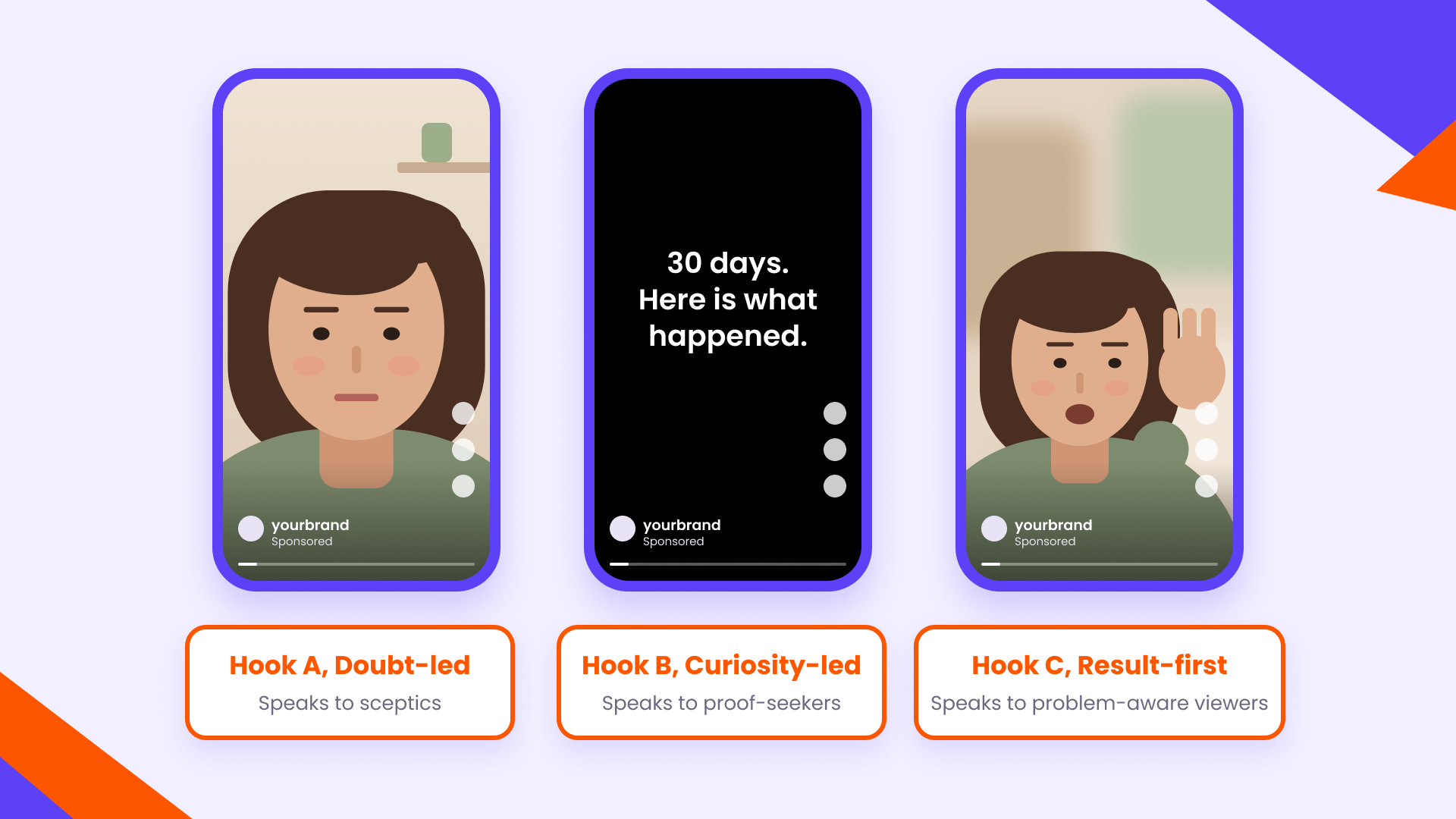
The winner tells you something one version never could: whether your cold audience is sceptic-led, proof-seeking or already problem-aware. That shapes every concept you develop next.
Persona variants test the narrative frame
The second kind of variant is one most brands never produce: concepts that hold the product constant and change the person the ad is written for.
Most creative testing is product-led, asking which way of presenting the product performs best. Persona-led testing asks which problem, which person and which life context the product belongs in. Two ads can share identical footage, claims and offers and still reach completely different people, because they open from different emotional starting points.
We did this with TUSHY, the US bidet brand. Their creative was performing but skewed heavily male, built around shock-value executions that capped their addressable market. The product had not changed; the audience they needed to reach had. We reframed around female household buyers, elevated in tone and still unmistakably TUSHY, opening from an entirely different emotional and demographic starting point. Across 223 new creatives in 90 days, the result was a 9.2% reduction in cost per purchase and a 12% increase in ROAS.
That did not happen in the ad account. The question that produced it was not which execution wins, but which person this product belongs to next.
4. The Seven Fields That Generate Diversity
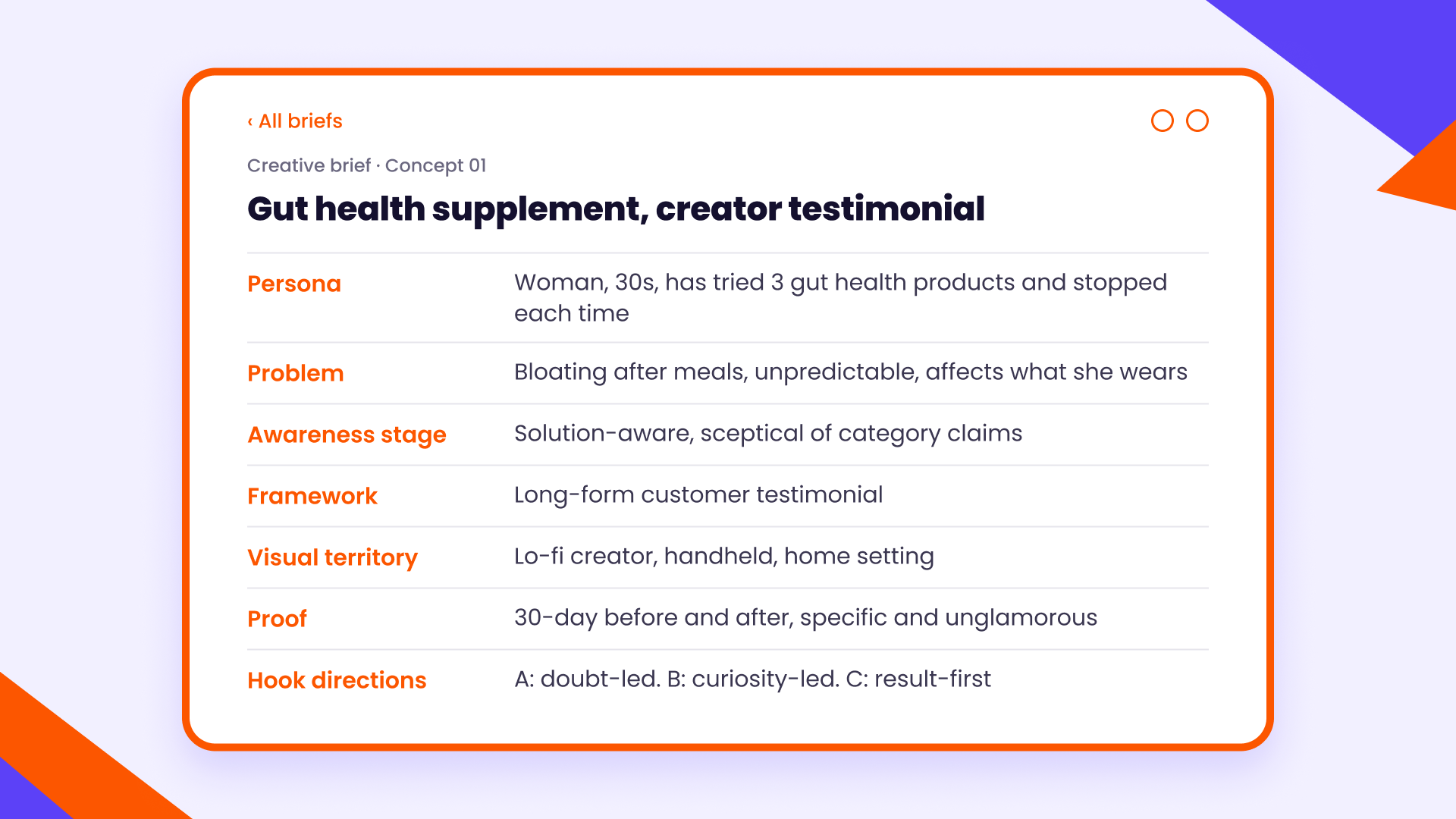
Most underperforming creative libraries trace back to a brief that specifies the product and the offer and leaves everything else to whoever is producing. Seven fields, filled properly, do most of the work.
1. Persona. The specific person this concept is for, named from your existing persona set. "Busy parents" is a demographic. "A parent of two who has tried three meal solutions this year and stopped each time in week three" is someone a writer can write for.
2. Problem. One problem per concept, stated in the customer's language rather than the product's. Briefs listing four problems produce ads that address none convincingly.
3. Awareness stage. Problem-unaware, solution-aware, brand-aware or most aware. This determines how much the ad must explain before the offer makes sense, and getting it wrong is the most common reason a strong concept underperforms.
4. Narrative framework. Problem-agitate-solution, tutorial, demonstration, social proof, founder story, trend-led or long-form VSL. Naming it is the cheapest way to stop every concept arriving in the same shape.
5. Visual territory. Creator-led UGC, static design, motion design or branded production, plus the treatment inside it. Specifying this stops four concepts arriving as four versions of your house style.
6. Proof. What makes the claim credible for this person: a review, a demonstration, a comparison, a number. Proof is the first field dropped when briefs get compressed, and its absence is usually why a well-made ad does not convert.
7. Hook directions. Three distinct opening approaches, written in before production rather than after, with the creative decision behind each one named.
A practical test for whether the template is working: strip the product shots from your current library, look only at the first five seconds of each ad, and ask whether a viewer would see five concepts or five versions of one.
For creator work, give the creator all three hook directions and shoot each in the same session. The incremental cost is minimal and the test value is significant. In our work with HelloFresh, creator-led content capturing real meal prep outperformed scripted lifestyle equivalents by 40% on TikTok, and the gap between those numbers came from a direction brief rather than a media strategy.
5. How to Read the Results
Briefing variants only pays off if the results can be read cleanly. Three questions cover it.
Did the concept fail, or the execution? Answerable only if you produced more than one execution. If all three hooks underperform against account benchmarks, the concept is the problem and the territory is worth retiring. If one clears benchmark and two do not, the concept is sound and you have learned which entry point works for that audience. A single underperforming execution tells you nothing about the concept.
How long before calling it? Long enough to clear the learning phase and accumulate meaningful conversion volume, which usually means at least 7 days and closer to 10 to 14 where volume is thin. Reading results in the first 72 hours is unreliable, because early collapse is far more often a delivery signature, from learning-phase instability or audience over-concentration, than a creative one. Thumbstop and hold rate are the exception, stabilising early and giving a directional read on the hook well before cost per result does.
Is the signal about the hook or the body? Weak thumbstop with healthy retention past three seconds points at the hook. Strong thumbstop with a sharp drop after five seconds points at what follows it, usually a payoff that does not match the opening. Strong retention with weak conversion points at the offer or the landing experience rather than the creative.
Fatigue signals work the same way, as creative feedback rather than media feedback. A declining click-through rate with a stable CPM means the creative has lost its pull. A rising CPM alongside a falling click-through rate means the same creative is reaching the same people repeatedly. The delivery labels confirm this after the fact rather than predicting it: "Creative limited" appears when cost per result exceeds your past ads but stays under twice as high, and "Creative fatigue" when it reaches twice or more. By the time either shows, you have paid for the diagnosis.
One rule worth holding to: when a concept shows early promise, refine before you replace. A concept generating engagement without converting may need a different benefit hierarchy in the first ten seconds, a different emotional register or a pace change in the edit. Those are brief decisions, so send it back to the creative team rather than the media buyer.
6. The Maths That Should Shape Your Output
30 concepts x 3 variants = 30 distinct clusters.
10 concepts x 9 variants = 10 distinct clusters.
Both produce 90 ads. The first gives the retrieval system 30 things to choose between. The second gives it 10.
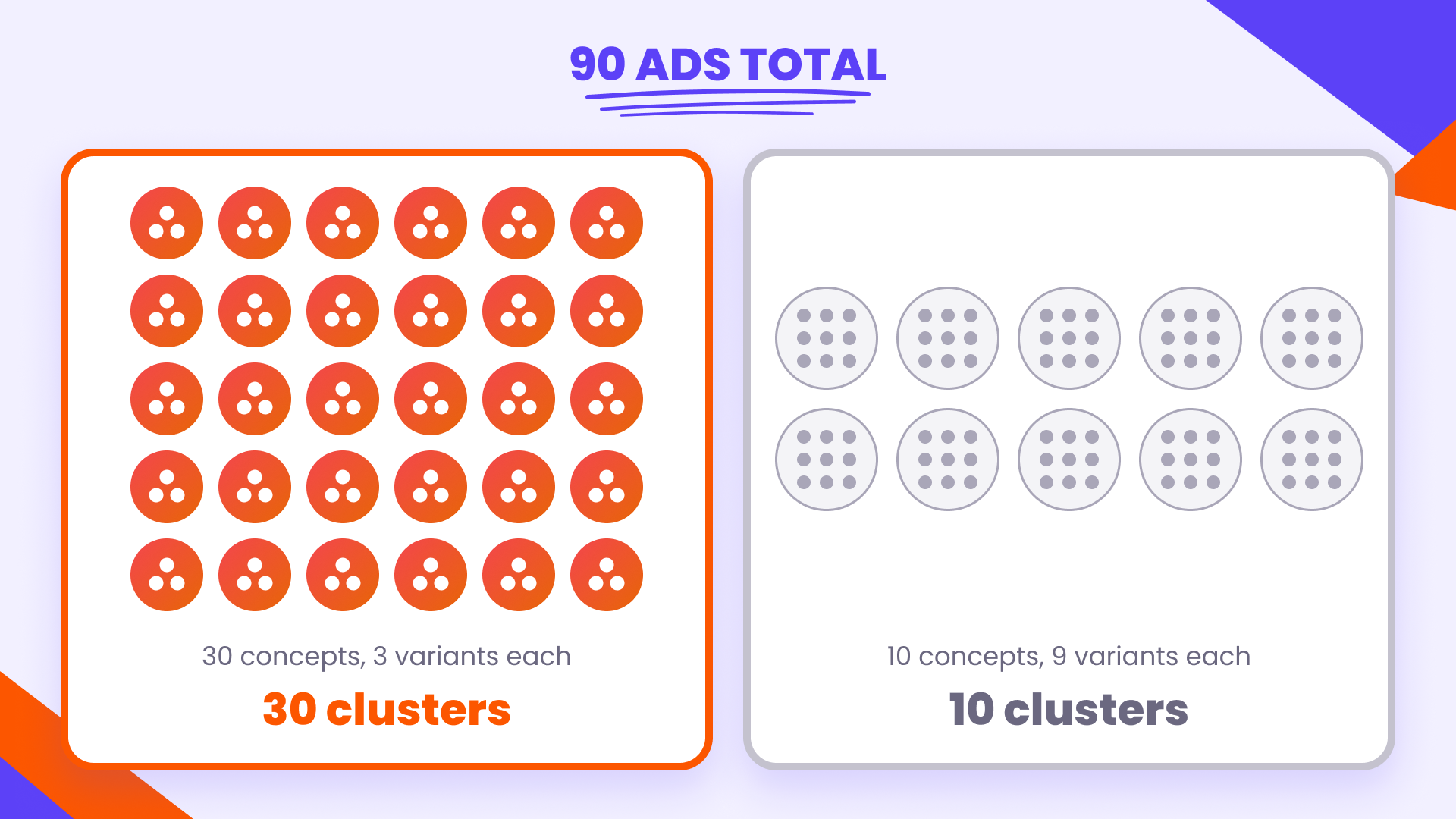
Two things follow from that. Map your monthly output across at least four format types, creator-led UGC, static design, motion design and branded production, and build width across all four before going deep on any one. And brief at least one concept a month that starts from a specific person rather than from the product, because those tend to generate disproportionate signal by reaching people who were not looking for the product but recognise themselves in the story.
We have set out the full picture on what counts as distinct in What Creative Diversity Actually Means.
Frequently Asked Questions
How many creative variants should you test per concept?
Three is a workable default for video, covering three distinct opening approaches rather than three cosmetic changes. Fewer and you cannot separate a failed concept from a failed execution. More and you are spending production budget on one territory when a new concept would open another.
How long should a creative test run?
At least 7 days, and often 10 to 14 where conversion volume is thin, so the test clears the learning phase. Thumbstop and hold rate stabilise earlier and give a directional read on the hook first.
What is the difference between concept testing and execution testing?
Concept testing asks whether the underlying idea resonates: the narrative, the person, the problem. Execution testing asks which version of that idea lands hardest. Running one execution per concept collapses the two and makes both unreadable.
How do you know whether a concept failed or the execution failed?
By producing more than one execution. If every execution underperforms, the concept is the problem. If one clears benchmark and the others do not, the concept works and you have learned which entry point suits that audience.
Should you test hooks before or after production?
Before. Hook directions belong in the original brief so all three can be captured in one session. Iterating afterwards means a second production cycle for something that costs almost nothing to build in upfront.
Does producing more ads improve Meta performance?
Only when the ads are conceptually distinct. Similar ads get clustered and effectively compete as one, so twenty versions of a single concept behave closer to one ad than to twenty.
How We Can Help
Most agencies will take your brief and produce against it. The work that changes performance happens one step earlier, in what the brief asks for in the first place.
We write briefs that specify the persona, the problem, the awareness stage, the framework, the proof and three hook directions before anything goes into production, then read the results back into the next round. That is why TUSHY's reframe worked: the change was in the brief, not the edit.
If your creative is being produced well and still plateauing, the brief is the first place to look.
Related reading:
- What Creative Diversity Actually Means (And How to Implement It)
- 12 Creative Formats Every DTC Brand Should Be Using
- Brand vs Performance Is a False Trade-Off
We are Aura Ads, a specialist performance creative agency for DTC and eCommerce brands. We help clients sell more online and grow at scale with data-driven creative delivered on a monthly basis.
Sources
- Nielsen and Nielsen Catalina Solutions, "When It Comes to Advertising Effectiveness, What Is Key?", meta-analysis of nearly 500 campaigns, 2017. nielsen.com
- Meta Engineering Blog, "Meta Andromeda: Supercharging Advantage+ automation with the next-gen personalised ads retrieval engine," December 2024. engineering.fb.com
- Meta Business Help Centre, creative fatigue recommendations: "Creative limited" and "Creative fatigue" delivery status definitions.
- Meta Performance 5 Framework, "Creative diversification drives 32% increased efficiency and 8% incremental reach," reported in Adweek, 2022. adweek.com

Subscribe to our newsletter

More blog posts
See All