How Much Ad Creative Do You Need for Q4?
When performance teams size a Q4 creative budget, they usually start with a production plan. How many shoots are needed, how many edits can be produced, and how many final assets should come out of each production block. That gives you a number of assets, but it answers a production question rather than a performance one.
The more useful question is how many new concepts need to enter the account each week to support the level of spend you're planning. That's the number that matters when you're trying to keep cost per acquisition stable through November and December, because creative doesn't just need to exist. It needs to enter the account at a rate that keeps pace with how quickly your audience is seeing it.
Creative doesn't expire, it gets used up
Creative fatigue isn't really a function of the calendar. It's a function of exposure.
Meta's Creative Fatigue research found that response falls as people see the same creative again and again, and it describes that relationship in exposures, not days. One 2026 benchmark of 368 creatives across 15 DTC accounts found a median active lifespan of 18 days on Meta, but 80% of those creatives never reached 100,000 impressions. Treat 18 days as a reference point, not a rule. TikTok's research also looks at how performance holds up under repeated exposure, rather than giving a lifespan in days.
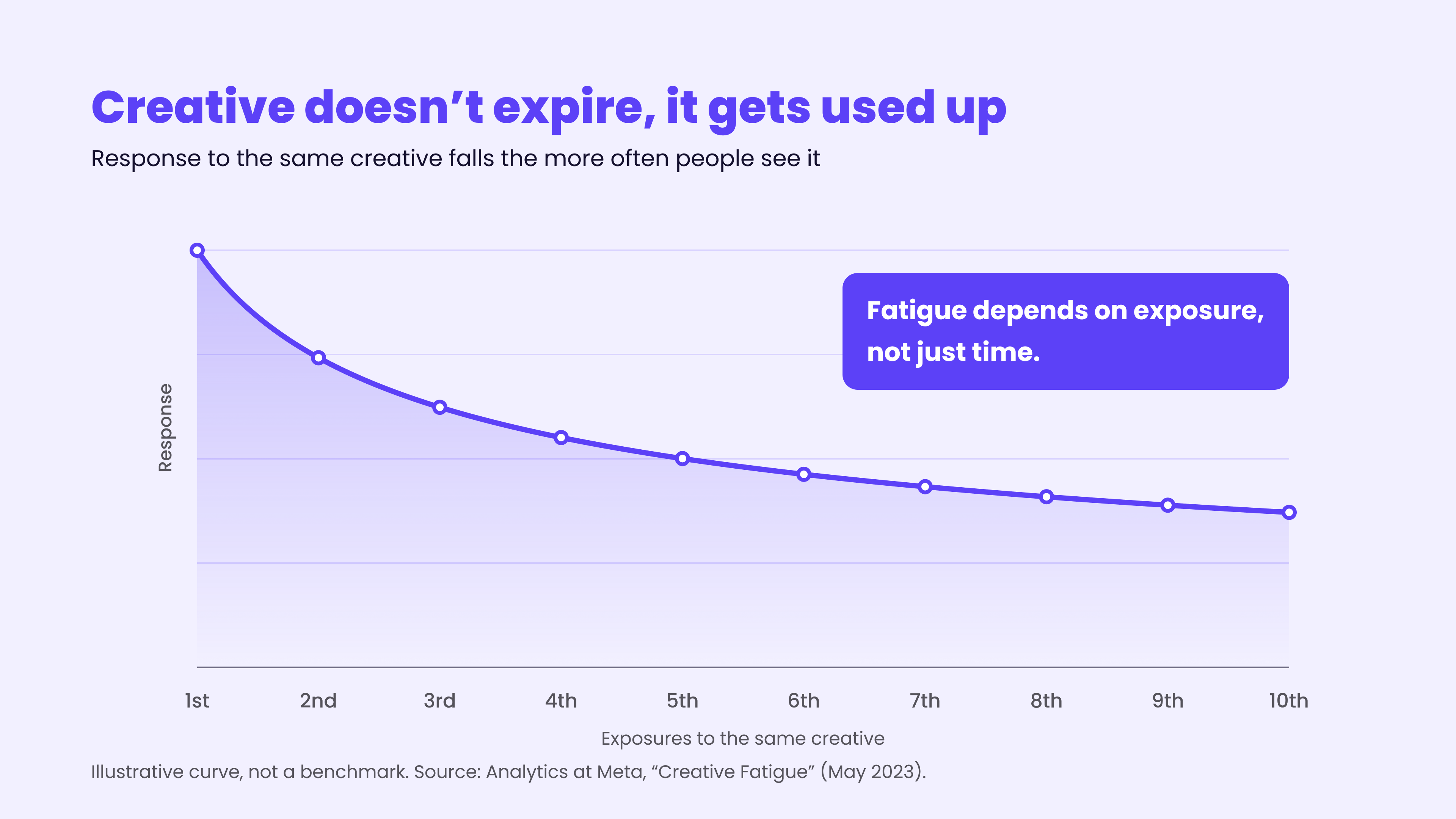
That figure is an output of how quickly a particular level of spend pushes a particular audience through repeated exposures. Increase the spend and you increase the rate at which those impressions accumulate, which changes the lifespan of the creative with it.
That's why a team that can reliably get a month out of an asset during the rest of the year can suddenly find that the same creative only lasts a couple of weeks in November. The audience hasn't necessarily changed. You're simply getting through the available impressions much faster.
Three pressures compound in Q4
The first pressure is spend. As budgets increase, impressions accumulate against the same reachable audience at a faster rate.
Then CPMs increase as more brands compete for those impressions. You're not only reaching people more quickly, you're paying more for each impression while doing it.
The third pressure is relative. Everyone else in the category is refreshing their creative too. A three-week-old asset might still be within your normal frequency range, but it's now sitting alongside a feed full of new Black Friday creative. Its relative appeal can fall even when its own delivery metrics don't look alarming yet.
The first two pressures are arithmetic, which means they can be planned for. That's where working out your required creative volume becomes useful.
The worked example
The figures below are illustrative, so you should replace them with your own numbers. The important part is the method.
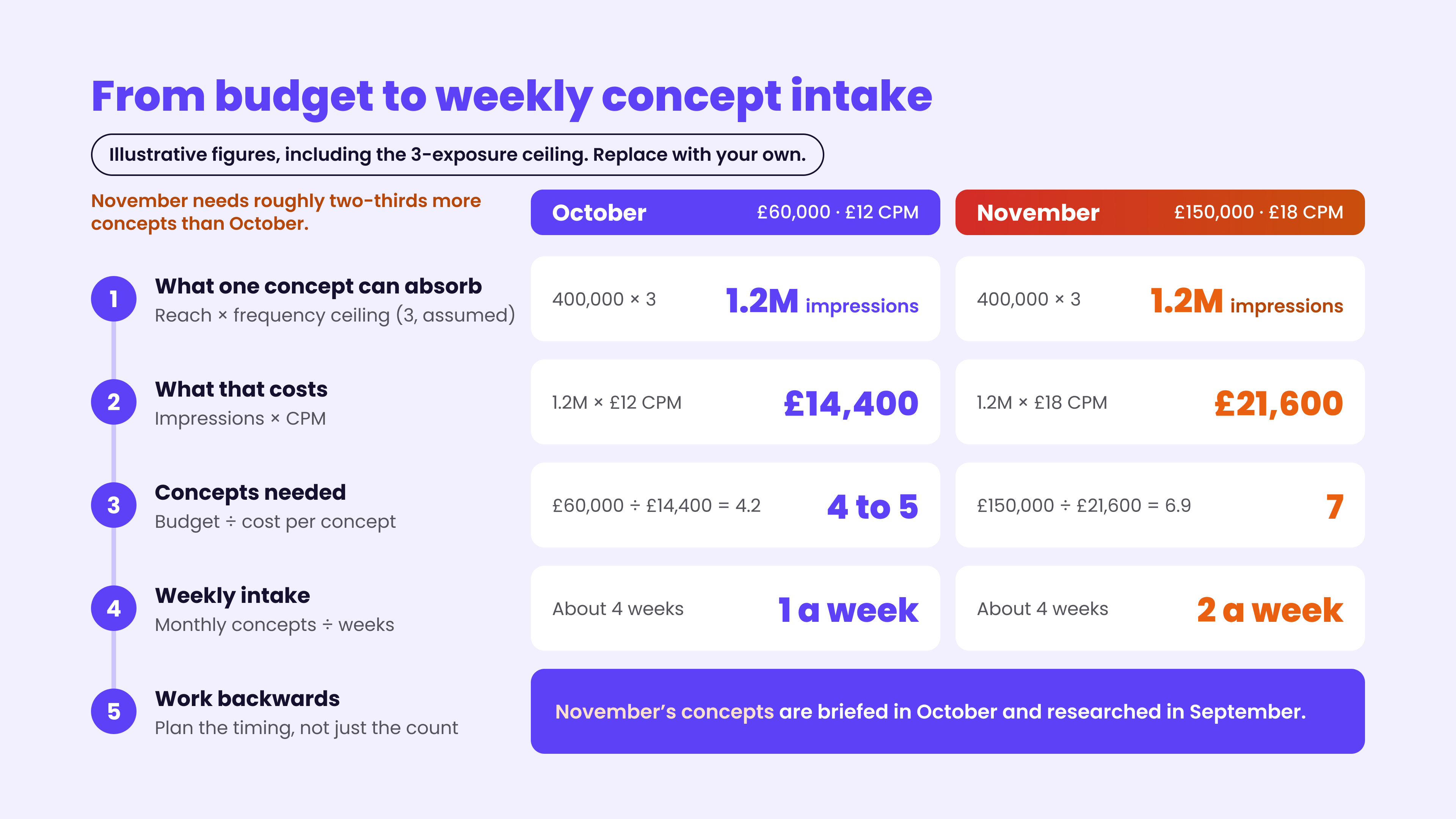
Let's assume October Meta spend of £60,000 increases to £150,000 in November. Your CPM is £12 in October and £18 in November, your effective reach is 400,000 people per concept, and you've identified a frequency ceiling of three exposures.
Step one: work out what one concept can absorb
If one concept can reach 400,000 people and you are comfortable with three exposures, that gives you 1,200,000 impressions before you hit that frequency ceiling.
Step two: turn that into a spend figure
At an October CPM of £12, those 1,200,000 impressions cost £14,400.
At a November CPM of £18, the same impressions cost £21,600.
That gives you the amount of spend a single concept can support before frequency pushes it beyond the point where your audience is likely to respond as efficiently.
Step three: calculate the number of concepts
Divide the monthly budget by the spend each concept can absorb.
In October, £60,000 divided by £14,400 gives you 4.2 concepts. In November, £150,000 divided by £21,600 gives you 6.9.
So, in practical terms, you're looking at roughly four to five concepts in October and seven in November.
Step four: turn that into a weekly intake rate
Now translate those monthly numbers into the rate at which new concepts need to enter the account.
That's roughly one new concept per week in October and two per week in November. If each concept is then produced in three to four executions, you're looking at six to eight new assets entering the account every week through peak.
This is the number that's much more useful for planning production than saying you need a certain number of ads for Black Friday.
Step five: work backwards
The other important part is timing.
November's concepts need to be briefed in October and researched in September. That's where the calculation becomes useful beyond simply telling you how many ads you need.
The figure that tends to surprise teams isn't the asset count. It's the idea count. In this example, November needs roughly two-thirds more distinct concepts than October, at exactly the point in the year when most teams have already stopped thinking about briefing new creative.
If you wait until the creative starts showing fatigue, you're already behind the number.
How to calculate your own creative requirement
Start with your last high-spend period, ideally last November. Take your five highest-spending ads and look at what happened around the point where cost per result started to deteriorate.
Find the reach and impressions at that point, then divide impressions by reach. That gives you the frequency at which your audience started showing signs of fatigue. It's a much more useful ceiling for your account than simply defaulting to three exposures because you've seen that number elsewhere.
Take the CPM from the same period and run the calculation again: reachable audience multiplied by your frequency ceiling gives you the impressions a concept can absorb; impressions multiplied by CPM, divided by 1,000, gives you the spend that concept can support; and your total budget divided by that figure gives you the number of concepts you need.
The output is a single planning number expressed as concepts per week. That's the number that should sit in your budget alongside production cost, rather than being buried somewhere inside a shoot or asset count.
What happens when the number is bigger than your production capacity?
For most brands doing this calculation for the first time, the answer will be bigger than what the team can currently produce. That's not necessarily a reason to immediately increase production. There are four levers you can pull, and only one of them involves making more creative.
Raise the frequency ceiling deliberately. If your own data shows that your audience can tolerate four or five exposures rather than three before performance starts to deteriorate, your concept requirement falls accordingly. That's a measurable trade-off rather than a guess. Some creative decay can be perfectly acceptable if you've made the decision consciously and understand what you're giving up in exchange for the additional capacity.
Expand reach per concept instead of simply increasing concept count. A concept that reaches 700,000 people can absorb nearly twice the spend of one reaching 400,000. Broader targeting and wider placement coverage can both increase the number of people each concept reaches, which is one reason simpler account structures can hold up better as spend increases.
Reduce the number of phases. Four phases gives you the fuller version of the plan, but not every brand has the production capacity to support that level of variation. If you can't properly service four phases, you're usually better off doing two properly than spreading the same creative too thinly across four. A phase supported by one tired concept isn't necessarily adding anything.
Reuse deliberately rather than accidentally. Last year's strongest performers can come back if the audience has turned over sufficiently and the creative has been out of market for long enough. Reversioning existing assets into new formats is also considerably cheaper than originating entirely new concepts. Neither replaces the need for new ideas, but both can extend the useful life of the creative system you've already built.
The wrong response is to hit your asset target by producing more variations of the same concepts. That's where this calculation is most commonly misapplied.
Seven concepts means seven ideas
Seven concepts means seven distinct ideas. It doesn't mean taking one idea and producing it in seven different formats.
Minor variations don't reset the exposure clock. Changing the headline colour, swapping the CTA or trimming two seconds from a video doesn't suddenly make the audience experience it as a completely new idea. Those assets are likely to be read as variations of the same creative and served to much the same pool of people.
If you fill seven production slots with re-crops and minor variations of one concept, you've paid for seven assets but only created one new idea.
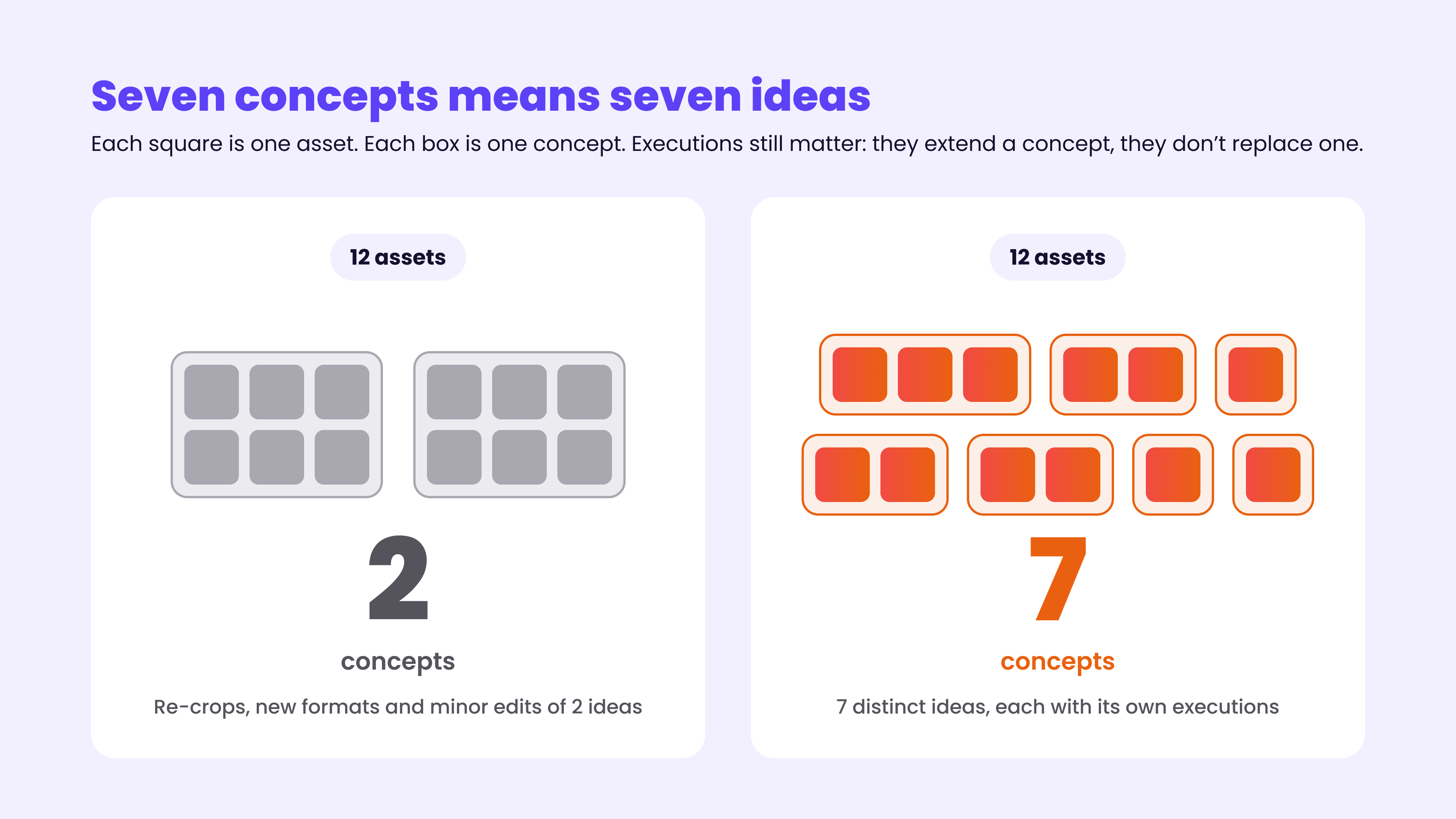
Executions still matter. You need different formats, lengths and placements to get a concept working across the account. But those executions extend a concept; they don't replace the need for new concepts.
Running the squint test across a Q4 batch before it goes live is a simple way to check this. If the assets all blur into one another when you look at them together, the number on your production schedule isn't necessarily the number of new ideas the account has actually received. We've covered the distinction between the two in What Creative Diversity Actually Means.
Don't wait for the delivery label
Where available, Meta may show "Creative limited" or "Creative fatigue" in Ads Manager's Delivery column. Meta's guidance on creative fatigue explains that these statuses are based on cost per result relative to past ads and are not available for every campaign setup. By the time a label appears, performance may already have deteriorated, so treat it as confirmation rather than the only trigger for action.
Frequency trends across seven-day windows and week-on-week cost per result can give you earlier signals that the current creative supply isn't keeping up with spend.
The goal isn't to wait until the platform tells you the creative is tired. It's to understand how quickly your account is consuming creative and make sure the next concepts are already in production before you need them.
Frequently asked questions
How many new ads should you launch each week?
There isn't a universal number. It depends on your spend, reachable audience and frequency ceiling. The calculation above turns those three inputs into a weekly concept intake figure, which is a much more useful planning number than taking a published benchmark for how many ads to run on Meta.
How often should you refresh ad creative?
There isn't a universal refresh schedule. Meta's research into creative fatigue links repeated exposure with declining response, while a 2026 benchmark across 15 DTC accounts reported a median active creative lifespan of 18 days on Meta. That result is specific to the accounts studied, and it shouldn't be treated as a fixed rule. TikTok's research looks at how creative effectiveness changes with repeated exposure, rather than giving a lifespan in days. Your ad creative refresh rate should be calculated from your own spend, reach and performance data rather than scheduled around an arbitrary number of weeks.
Is creative fatigue worse in Q4?
Effectively, yes, although the mechanism hasn't changed. Higher spend pushes more impressions against the same reachable audience at a faster rate, while higher CPMs mean each of those impressions costs more. The result is that the same level of creative decay becomes more expensive during peak.
Do more ads always improve performance on Meta?
No. More ads only help if you're adding meaningful conceptual variety. Ads that are visually and semantically similar can be treated as variations of the same underlying idea, so 20 versions of one concept don't necessarily behave like 20 distinct ads.
The point of increasing creative volume is to increase the number of useful ideas entering the account, not simply to increase the asset count.
What frequency is too high on Meta?
There isn't a universal threshold because the answer depends on the account, audience and spend level. Meta's Creative Fatigue research found that response tends to decline with repeated exposure, but it doesn't set a number of exposures after which every account will see meaningful decay. Calculate your own ceiling from historical reach and impressions at the point where cost per result began to deteriorate.
Should creative budget be split between production and testing?
It's more useful to think about them as one connected system driven by your required creative intake. The purpose of production is to feed testing at a rate that the account's spend can actually support.
Sizing production around a shoot is one of the easiest ways to end up with enough assets on paper but not enough new concepts entering the account in December.
How we can help
Q4 has a habit of exposing the weaknesses in a creative pipeline that looked perfectly adequate during the rest of the year.
We build always-on production and testing systems designed to keep distinct concepts entering the account at a rate the spend can support. The aim isn't to produce more creative for the sake of having more ads. It's to make sure there is a consistent supply of new ideas for the account to learn from as spend scales.
HelloFresh is the clearest example of this at scale: a closed loop between hypothesis, production, validation and learning that supported a 134% increase in Meta spend and 251% on TikTok.
That increase was possible because the concept supply existed first.
Related reading
- Black Friday Creative Strategy: How to Plan for a 10-Week Peak Season
- What Creative Diversity Actually Means (And How to Implement It)
- 12 Creative Formats DTC Brands Should Be Using
We are Aura Ads, a specialist performance creative agency for DTC and eCommerce brands. We help clients sell more online and grow at scale with data-driven creative delivered on a monthly basis.
Sources
- Analytics at Meta, "Creative Fatigue: How advertisers can improve performance by managing repeated exposures" (10 May 2023).
- Meta Business Help Centre, "About creative fatigue recommendations in Meta Ads Manager".
- TikTok for Business, "Creativity pays dividends: Effective creative on TikTok drives long-lasting impact for brands" (5 May 2025).
- Interconnections, "The 2026 Meta Creative Fatigue Benchmark" (2026; 368 creatives across 15 DTC accounts).
Source note: Meta's and TikTok's research discusses repeated exposure and creative fatigue, but neither establishes a universal creative lifespan in days. The 18-day median comes from Interconnections' 2026 dataset of 368 creatives across 15 DTC accounts. It is a sample-specific benchmark, not a universal rule.

Subscribe to our newsletter

More blog posts
See All