Black Friday Ad Ideas: Angles That Work When Everyone is on sale
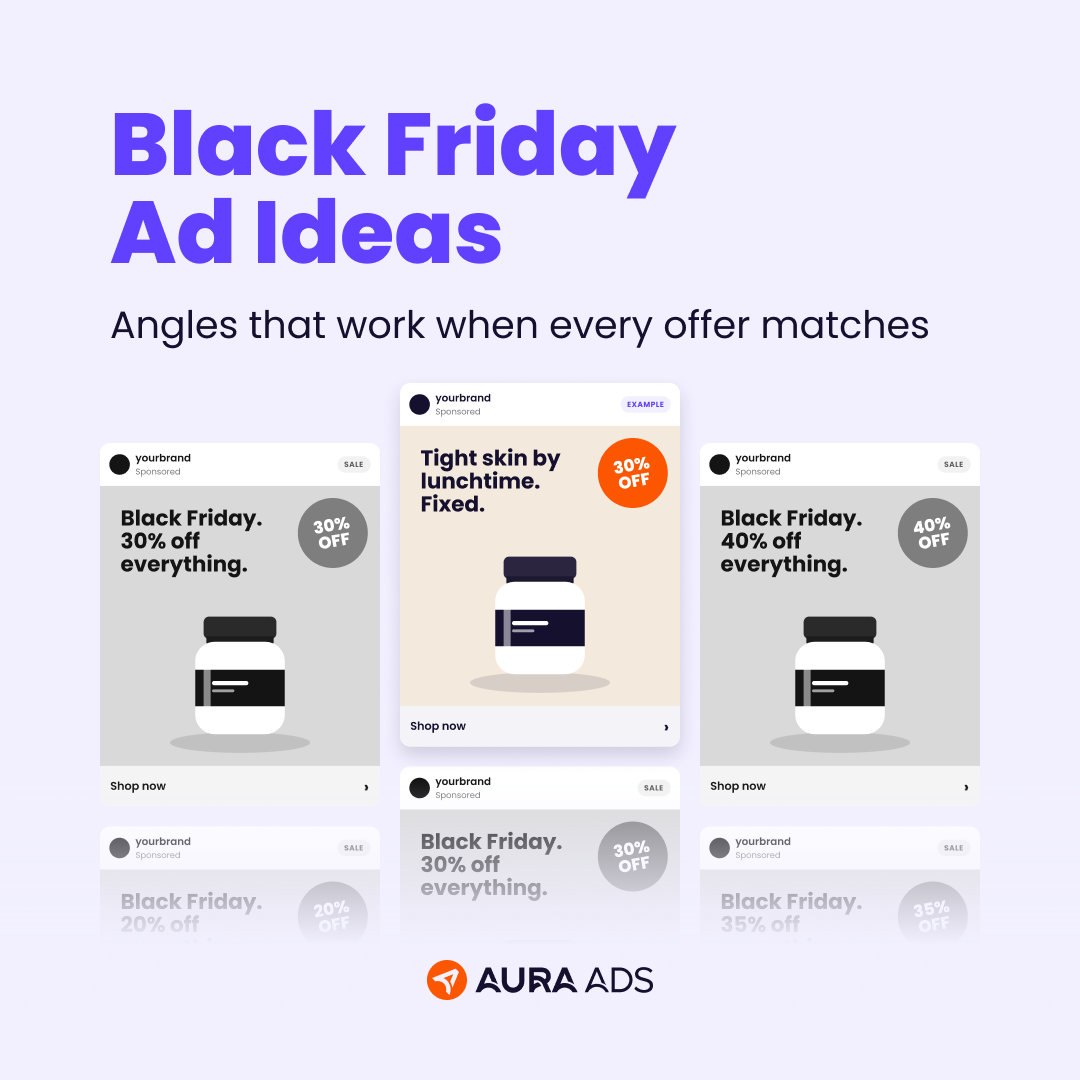
Black Friday is the one time of year when your offer stops being an advantage. Everyone else has it too.
For most of the year, creative can lead with the product and the offer without too much difficulty because both are reasonably distinctive. Come November, that changes. Almost every competitor in the category is running a comparable discount at the same time, so the things that normally give an ad a reason to stand out start to look remarkably similar.
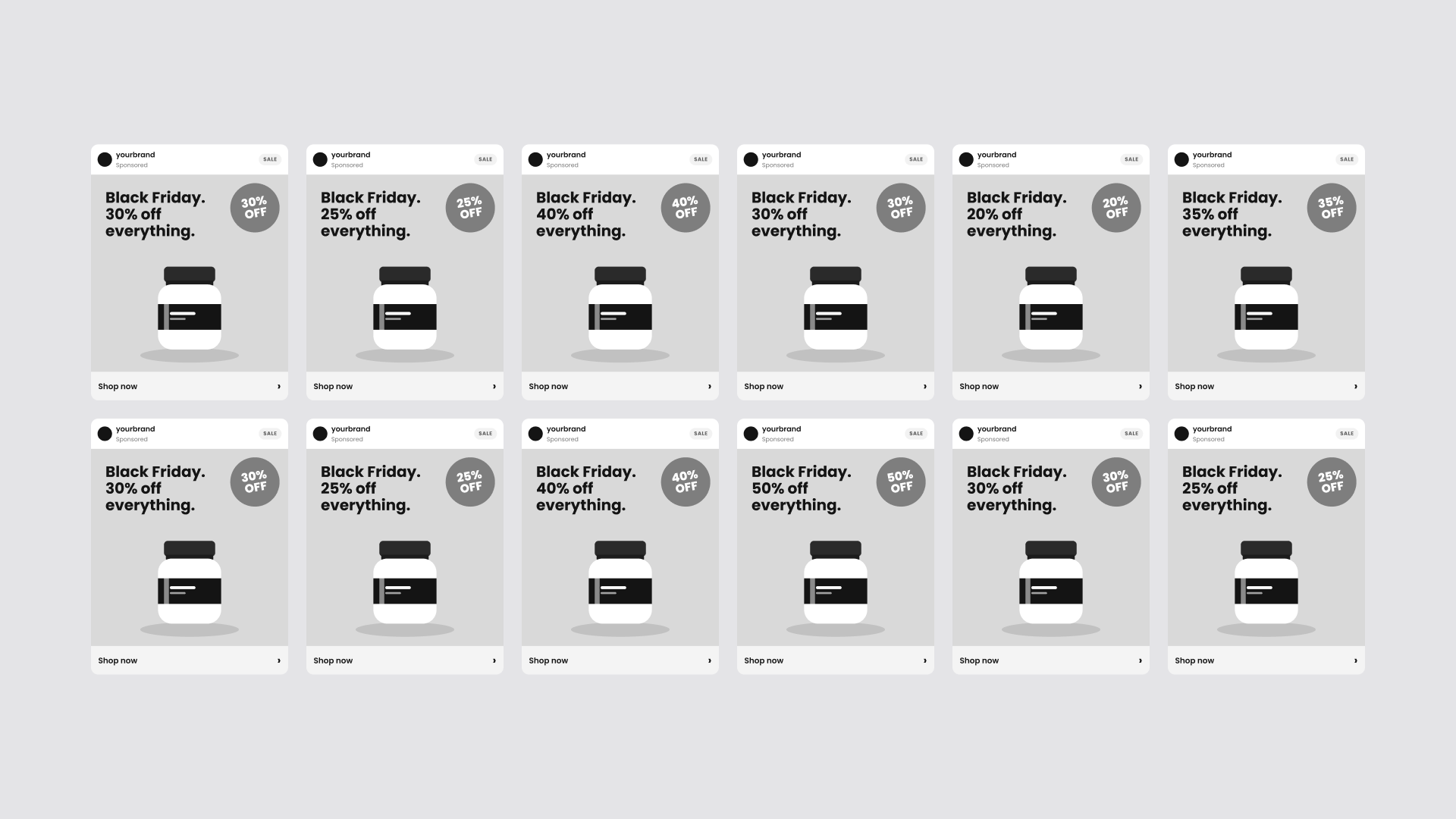
Open a few competitor ad libraries in the last week of November and the pattern becomes pretty obvious. The same percentage discount, the same countdown, the same product photographed against the same kind of background, often with the same badge sitting in the corner. An entire category converges on one message at the most expensive point in the auction year, and the offer stops setting you apart the moment everyone else is running one too.
That leaves the creative angle as one of the few variables you still have meaningful control over.
This is a conceptual problem, not a design problem
When creative stops standing out, the instinct is usually to fix it visually. Make the discount badge bigger, use bolder type, change the background or find a better product shot. Those things can improve the execution, but they don't address the underlying problem if every ad is still making the same argument.
Visual diversity matters because it stops your ads blurring into one another. But conceptual diversity gives the ads something different to say. It lets you talk to a different person, about a different problem, from a different perspective. During a discount period, when every brand is compressing its message down to the same percentage off, that conceptual range becomes much more valuable.
We've written more about what conceptual and visual diversity mean in practice, but Black Friday is a particularly useful test case. If the offer is no longer doing much of the differentiation for you, the ideas behind your creative have to do more of the work.
A simple way to test this is to read the scripts of your five planned BFCM ads one after another. If all five are essentially arguing that the product is good and it's currently cheaper, you don't have five concepts. You have one concept expressed through five executions. That's a useful distinction to make before production starts, because changing the format doesn't give you the conceptual range you need.
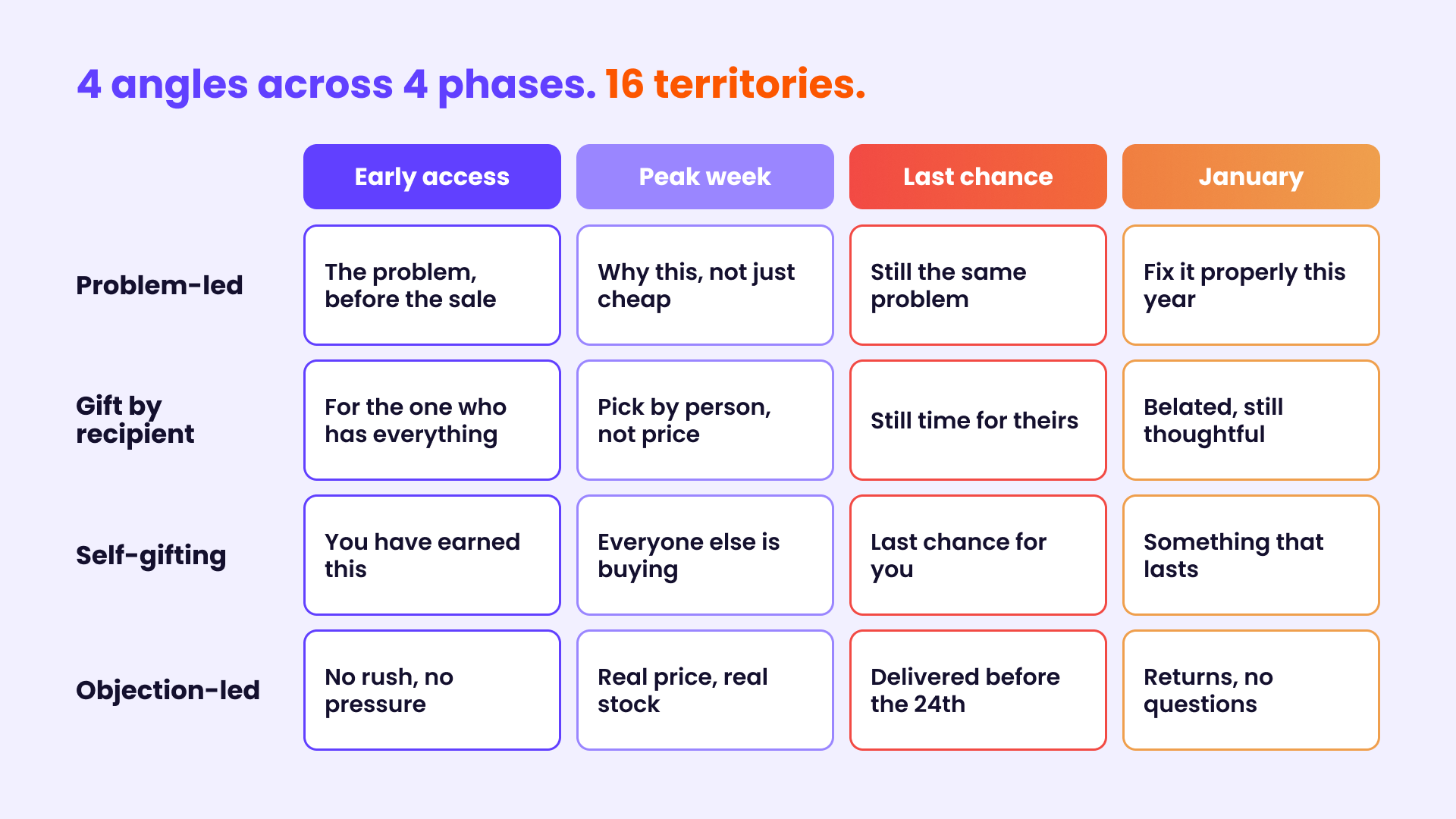
Four angles that can survive a discount period
Lead on the problem rather than the price
A discount is a reason to buy now, but it isn't necessarily a reason to buy in the first place. An ad that starts with the problem your product solves and brings the offer in later can reach people who weren't already shopping specifically for a sale.
That matters because competitors leading with price are all competing for the same pool of people who are already looking for a deal. If your creative can give someone a reason to care about the product before you give them a reason to buy it today, you're opening up a different part of the audience.
Split the gift angle by recipient
An ad about buying something for a parent and an ad about buying it for a housemate are two different pieces of creative, even if they're promoting exactly the same product. The person buying might have a different motivation, the recipient has different needs, and the language that makes the product relevant will change accordingly.
Most brands run a single gifting ad, treating the recipient as context rather than as a useful audience signal. Breaking that out gives you another way to create meaningful variation without changing the product or the offer.
Give permission for self-gifting
Not every Q4 purchase is made for someone else. A meaningful share of people are buying for themselves, and they're in a different emotional state from someone shopping for a gift.
The framing therefore changes. Instead of generosity, you're talking about justification. The discount becomes the permission slip rather than the entire pitch: something that makes the buyer feel more comfortable spending on themselves.
It's a relatively simple shift, but it creates another audience and another reason to buy that a gifting-led Black Friday campaign can easily overlook.
Answer the objection
As Christmas gets closer, the questions that stop people buying become increasingly practical. Will it arrive in time? Can I return it after Christmas? Is the sale price actually a good deal?
These are often the questions sitting between intent and purchase in the final fortnight, yet very few brands build creative around them. That's precisely what makes them interesting. If everyone else is telling people why they should buy, there is an opportunity to create ads that deal with the thing stopping them from buying.
Four angles applied across four phases of the calendar gives you 16 conceptual territories before a single asset has been shot. The point isn't that every brand needs exactly 16 ads. It's that you can create considerably more creative range by changing the argument, rather than endlessly changing the execution.
Where to find new angles
You can find examples of how your customer speaks in reviews, support tickets, ad comments and last year's performance data. The job is to turn that information into a set of problems, audiences and motivations that your creative can actually address.
Your own reviews. Sort by recency and read the three-star reviews first. They're particularly useful because they often tell you both what worked and what nearly stopped someone buying. Those hesitations are where objection-led creative comes from, and they tend to be much more useful for finding angles than simply reading a list of positive reviews.
Support tickets and pre-purchase questions. Whatever people are asking before buying in October is likely to be relevant in November too, only at higher volume and with less patience. If customers repeatedly need reassurance about delivery, sizing, returns, ingredients or compatibility, that's not just a customer service issue. It's a potential creative angle.
Comments on your existing ads. These give you objections in the language customers actually use. They can show you where your current creative isn't answering a question, or reveal a use case that you hadn't considered. For copy development, that raw customer language is often more useful than trying to manufacture a clever line in a brainstorm.
Last year's Q4 winners, read properly. Rather than simply noting which ads performed, look at the problem each one addressed and who it was speaking to. You may find that your winners cluster around two or three recurring problems. If that's the case, the untouched problems become the obvious places to explore next.
Organic social and creator comments. These can be particularly useful for spotting use cases and buyer types that never made it into the original persona set. They're also a good source of different gifting recipients and motivations, which can give you additional territory without changing the product itself.
None of this replaces proper customer voice analysis and persona work. That takes considerably longer and should inform your creative throughout the year rather than being something you do in the final weeks before Black Friday. But if you're short on time, these sources are enough to build a defensible angle set without starting from scratch.
Personas do more work in November, not less
It's easy to assume that a sale flattens the audience because everyone is responding to the same offer, so segmentation becomes less important. In practice, the opposite can be true.
During a discount period, every competitor is speaking to the same buyer: the person already comparing prices within the category. The people your creative can reach without fighting over the same message are the ones nobody else is addressing. To do that, you need to understand what problem they have, what motivates them to buy and how they describe that problem in their own language.
A useful exercise is to map every planned BFCM asset to a persona and a problem, then count the distinct combinations rather than simply counting the number of ads. It is surprisingly common to have 12 planned ads that actually cover only two persona/problem pairs.
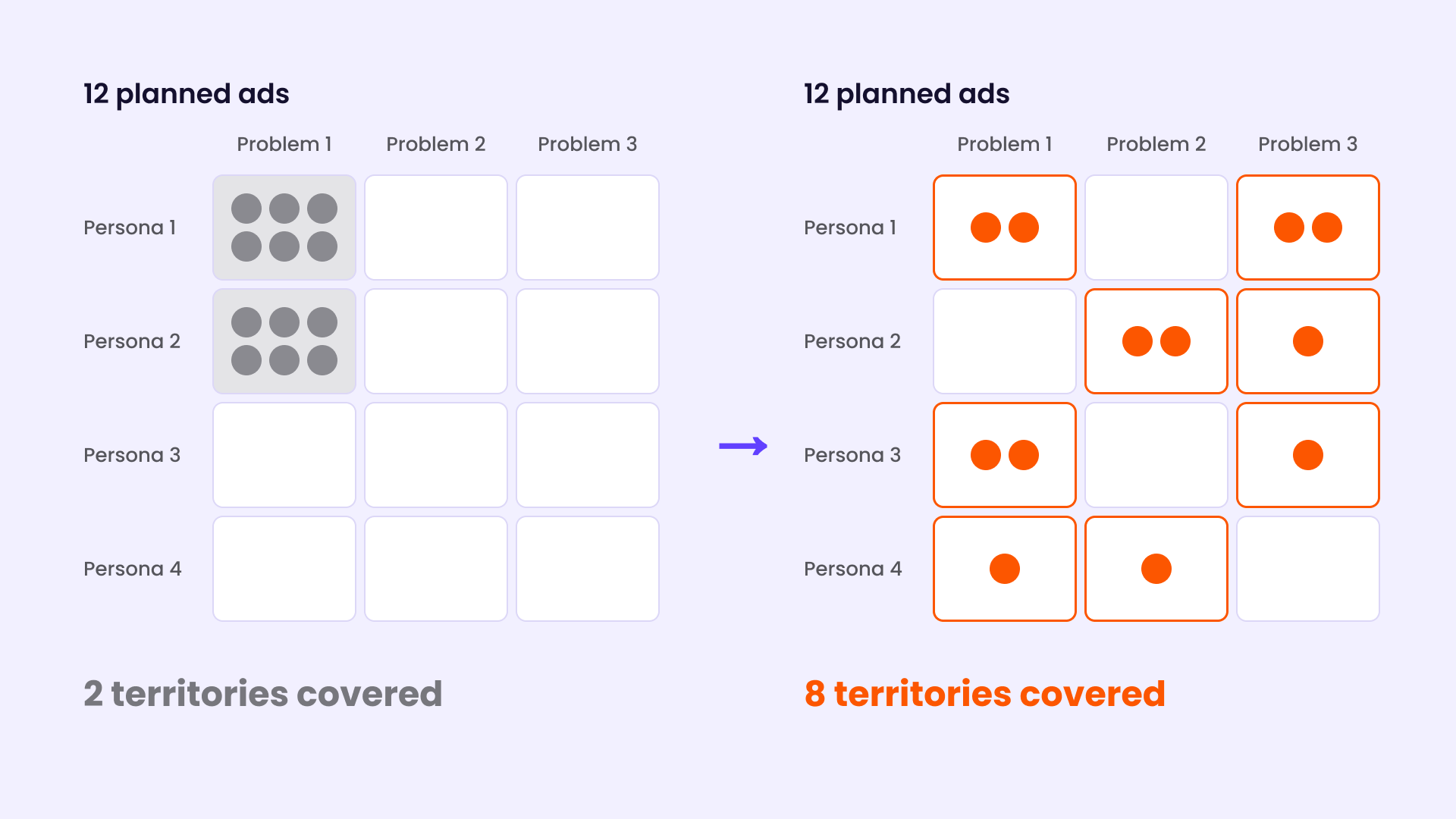
That looks like a large ad library on paper. Conceptually, it's still two ideas.
Where this tends to go wrong
The first risk is angle drift, where conceptual range becomes an excuse to abandon the brand for the length of the sale. More angles shouldn't mean becoming a completely different brand during peak season.
Gousto is a useful example here. In 2025, 706 persona-led ads were produced by changing who the creative came from rather than what the brand stood for. The angle moved, but the brand didn't. That's the balance you want: enough variation to give the system different things to work with, without losing the identity that makes the brand recognisable. We've written more about that in Brand vs Performance Is a False Trade-Off.
The second risk is confusing angles with formats. A UGC cut, a static and a motion version of the same argument are three executions of one angle. That's useful for placement coverage, but it isn't conceptual range. If the person you're speaking to, the problem you're addressing and the argument you're making are all unchanged, you've changed the format rather than the idea.
The third is timing. An angle that lands still needs the same production runway as one that doesn't, which means deciding on it in mid-November is usually too late. By the time it has been briefed, produced, approved, launched and given enough time to generate useful data, the phase you created it for may already have passed.
Frequently asked questions
What makes a good Black Friday ad?
When discounts match across a category, the differentiator is usually the angle rather than the offer. Ads that open on a specific problem for a specific buyer, then use the discount as the reason to act now rather than the entire reason to buy, can give you access to people your competitors aren't addressing with the same message.
How do you stand out on Black Friday when everyone has the same discount?
By covering conceptual territory that your category isn't covering. That means varying the problem, persona, awareness stage and framework across your creative, rather than simply varying the visual treatment of a single message.
How many ad angles do you need for Black Friday?
Enough to cover the phases of your sale calendar without repeating the same concept inside each one. Four angles across four phases gives you 16 territories, which is a reasonable target for a brand with the production capacity to support it. The exact number matters less than making sure the ads aren't all making the same argument.
Should Black Friday creative mention the discount in the first three seconds?
It depends on the phase. During peak week, when attention is short and comparison is active, leading with the offer can make sense. During early access and problem-led prospecting, opening on the discount can narrow the ad towards people who are already shopping for deals rather than people who might be persuaded by the underlying problem.
Does self-gifting really matter in Q4?
A meaningful share of Q4 purchases are made for the buyer rather than as gifts, and that buyer is in a different mindset. Creative that frames the discount as justification rather than generosity gives you a way to speak to a group that gifting-led campaigns can overlook.
When should Black Friday creative be finalised?
Production should be finishing as November begins. An angle decided halfway through November still needs to be produced, tested and scaled, and by the time that's happened, the phase it was written for may already have passed.
How we can help
The brands that hold performance through a discount period aren't necessarily the ones with the sharpest offer. More often, they're the ones covering more conceptual territory than the rest of their category.
We build Creative Operating Systems that map personas and angles before production begins, so the ad library covers different territory rather than repeating a single message in multiple formats. The aim is to give every piece of creative a job to do, while making sure the overall system has enough range to keep producing useful signals.
Who Gives A Crap is a good example. It's a commoditised category with a distinctive brand voice to protect, scaled across three markets at a 21% concept win rate and 70% growth in the UK. That combination is familiar to almost every brand during November: you're operating in a category where the offer is easy to match, so the creative has to do more of the differentiation.
Related reading:
- Black Friday Creative Strategy: How to Plan for a 10-Week Peak Season
- What Creative Diversity Actually Means (And How to Implement It)
- Brand vs Performance Is a False Trade-Off
We are Aura Ads, a specialist performance creative agency for DTC and eCommerce brands. We help clients sell more online and grow at scale with data-driven creative delivered on a monthly basis.
Sources

Subscribe to our newsletter

More blog posts
See All