Black Friday Creative Strategy: How to Plan for a 10-Week Peak Season
Your Black Friday campaign might last four days. Your Black Friday creative problem lasts much longer.
By the time peak season arrives, most DTC brands are spending more, competing against more advertisers and putting more impressions through the same audiences. At the same time, customers aren't all in the same buying mindset. Someone getting early access in November is behaving differently from someone comparing offers on Black Friday, someone waiting for a last-chance deal, or someone shopping again in January.
That creates a problem for the creative team. You don't just need more ads. You need enough different ideas, formats and messages to keep the account learning as spend increases, while making sure the creative still feels like the same brand.
That's where a lot of Q4 creative plans fall short. They plan for the event, not the system needed to support it, building around one Black Friday campaign, one big production push and a handful of offer variations. The result is plenty of assets, but not necessarily enough creative range to support 10 weeks of increasingly competitive paid social.
Black Friday falls on 27 November this year, with Cyber Monday on 30 November. But the period you're producing for starts with Singles' Day on 11 November and can run into late January.
That's closer to 10 weeks than one weekend.
So the question isn't just "what ads should we make for Black Friday?"
It's "what does our creative system need to produce, test and learn across the whole peak period?"
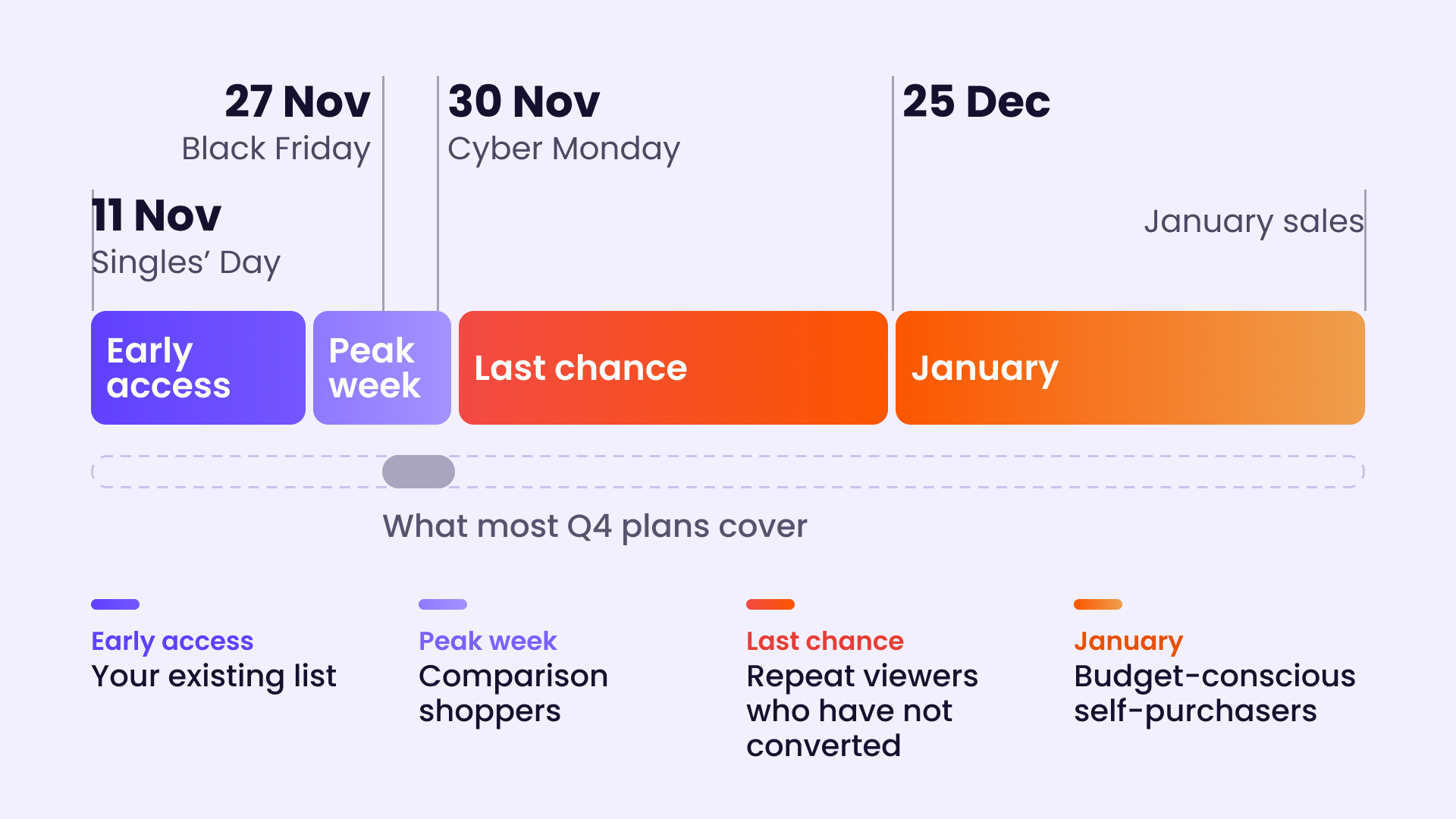
One campaign cannot do the job of four
The mistake is treating the entire season as one audience with one reason to buy.
The people you reach at the beginning of November are not necessarily the same people you'll be trying to convert on Black Friday. Even when they are the same person, their level of intent and the information they need from the creative can change significantly as the season progresses.
That means the creative strategy needs to evolve with them.
Early access: give existing customers a reason to act first
Early access is typically aimed at people who already know the brand and may already be considering a purchase. They don't need a lengthy introduction to who you are or what you sell. They need a reason to act now rather than wait.
That makes recognition and exclusivity more useful than heavy-handed urgency. They've been on your list, they've opted in, and they're being rewarded with access before everyone else.
In practice, that sounds less like "30% off, 48 hours only" and more like "you've been with us a while, so you're seeing this before anyone else." Same discount, different reason for the ad to exist.
The creative job is therefore less about convincing someone from scratch and more about turning existing intent into an earlier purchase.
Peak week: make the value obvious
Peak week changes the environment completely.
Customers are comparing brands, offers and products at the same time, while advertisers are competing for some of the most expensive impressions of the year. Your creative has less time to earn attention and less room to make the audience work out what you're offering.
This is where clarity matters. The offer needs to register quickly, the product needs to be understood quickly, and the reason to choose you needs to be clear.
The practical version: what you're selling, what it costs, and why it's better than the three other ads doing the same thing, understood in the first second. A slow build that worked in September will be scrolled past in peak week.
That doesn't mean every ad needs to become a giant discount graphic. It means the creative needs to work in an environment where almost every other brand is making its offer equally obvious.
Last chance: give urgency a reason to exist
By the last-chance phase, some of the people you're reaching may have already seen your offer several times without buying.
That's where real urgency can become useful, but only if there's something behind it. A shipping deadline, limited stock or an expiring price gives the audience a reason to act now.
"Order by Thursday for delivery before the 24th" works because it names a consequence. "Last chance, ends soon" doesn't, because it names nothing.
A countdown with no meaningful consequence trains the audience to wait. If customers have seen the same "last chance" message three times and another sale appears shortly afterwards, the deadline becomes less persuasive each time.
The creative needs to make the consequence of waiting clear, not simply make the countdown bigger.
January: change the reason to buy
January is where carrying the same Black Friday creative forward becomes particularly easy to spot.
The gifting period is largely over. Customers have just come through the biggest spending period of the year, and the context for their next purchase has changed. Value, quality and personal relevance become more important than gifting urgency.
The message moves from "this makes a great gift" to "this is worth the money." The brand hasn't changed. The reason someone buys from it has.
That's why January needs its own creative thinking rather than another round of December assets with the dates changed.
Peak season starts before peak season
The most useful thing we've learned about Q4 didn't come from a November campaign. It came from what happened in Q3.
The lesson wasn't simply that more creative helped. It was that the creative system was already working before the acquisition pressure arrived.
Working with Tonies, the screen-free audio storybox brand, the objective was to build consideration through Q3 and into Q4, on the basis that improving brand salience ahead of the key acquisition period would allow for more aggressive scaling once peak arrived. We produced over 100 assets in the first month and more than 300 pieces of unique creative across six months, mixing polished brand-led work with creator content and building bespoke assets for each channel rather than reversioning one set across all of them.
The outcome was a 2.5x increase in year-on-year ad spend, a 1.8x increase in sales volume, and an 80% year-on-year increase in purchases driven through acquisition on Meta alone.
That Q3 work meant the account entered Q4 with more consideration already built, rather than trying to create demand and capture it at the same time. It's the part most Q4 plans skip, and it's the reason a September start is recoverable while a November start isn't.
The account structure doesn't need to change with the creative
Four different phases might sound like four different campaigns. They don't need to be.
Meta's Andromeda system is designed to work from a large pool of eligible creative, narrowing that pool before ranking determines what an individual sees. When multiple ads are effectively saying and showing the same thing, the system has little reason to serve more than one of them.
That's why creative diversity matters more than simply increasing asset volume. And it doesn't mean rebuilding your campaign structure every time the season moves into a new phase. Constantly restructuring the account around each phase creates disruption at exactly the point where you want the system to have more creative to work with.
The better approach is usually to keep the account structure relatively simple and let the creative carry the variation.
Think of the phase as a property of the creative rather than a reason to rebuild the account.
That's a broader principle we use across Meta Ads: give the platform a diverse pool of different creative, then let testing tell you which concepts deserve more spend.
The real Q4 bottleneck isn't production. It's thinking.
You can produce another static. You can cut another UGC edit. You can resize an existing asset for another placement.
What takes longer is deciding what the next ad should say.
Good Q4 creative starts with understanding the customer, not booking a shoot. Which persona are you trying to reach? What problem are they solving? What do they already know about the brand? What objection is stopping them from buying? What is different about their mindset at this point in the season?
Those decisions determine the concepts.
And those concepts determine what production needs to create.
This is why the most useful thing to lock early isn't necessarily your shot list. It's the persona and angle set that your production team can work from throughout the season.
If you get that right, production becomes much easier to scale. If you don't, it's very easy to end up with 30 new assets that are all saying the same thing.
What each phase needs to answer
You don't need to reinvent the brand every few weeks. You do need to make sure each phase has a reason to exist creatively.
A useful phase brief should answer five questions.
Who are we talking to? Define the persona rather than defaulting to "DTC customer" or "Black Friday shopper". Different audiences have different motivations, objections and reasons to trust you.
How aware are they? Someone who has been on your email list for six months doesn't need the same introduction as someone discovering the brand for the first time during peak week. The amount of context your creative needs to provide changes with awareness.
What's the idea? The narrative framework should give the concept somewhere to go. Problem-led creative, product demonstration, founder storytelling, social proof, comparison and direct response all create different routes into the same product.
What should it look and feel like? High-production brand creative, creator content, lo-fi UGC, static design and motion all give the audience a different experience. Format diversity is useful when it creates different ways into the product, rather than simply producing the same ad in different dimensions.
What proves the claim? Reviews, demonstrations, comparisons, guarantees and customer stories can all give the audience a reason to believe what you're saying. Without proof, even a strong proposition can struggle to move someone from interest to action.
Those five questions are easier to see than to describe, so here they are applied to a single offer.
The same offer, briefed twice
Take a brand running 30% off across the range, and brief it for two phases.
Early access
- Persona: repeat customer, two or more orders, on the list over six months
- Awareness: knows the brand, knows the product, has bought before
- Idea: founder to camera, thanking the list and opening the sale early
- Look and feel: lo-fi, handheld, unpolished on purpose
- Proof: none needed. They've already bought
Peak week
- Persona: cold, in-market, comparing options in the category
- Awareness: may not know the brand at all
- Idea: product demonstration with the offer stated in the first frame
- Look and feel: high production, bright, legible at thumbnail size
- Proof: review count and rating on screen
Same product. Same discount. Two ads with almost nothing in common, because the five answers are different in every row.
That's what phase briefing means in practice. The goal isn't four completely separate creative strategies. It's enough variation that the account has different things to learn from as the audience and buying context change.
Before you make anything new, work out what's already working
Q4 production doesn't need to start with a blank page.
Before commissioning a new batch of creative, audit what's already in the account and put it into three groups: retire, refresh or leave alone.
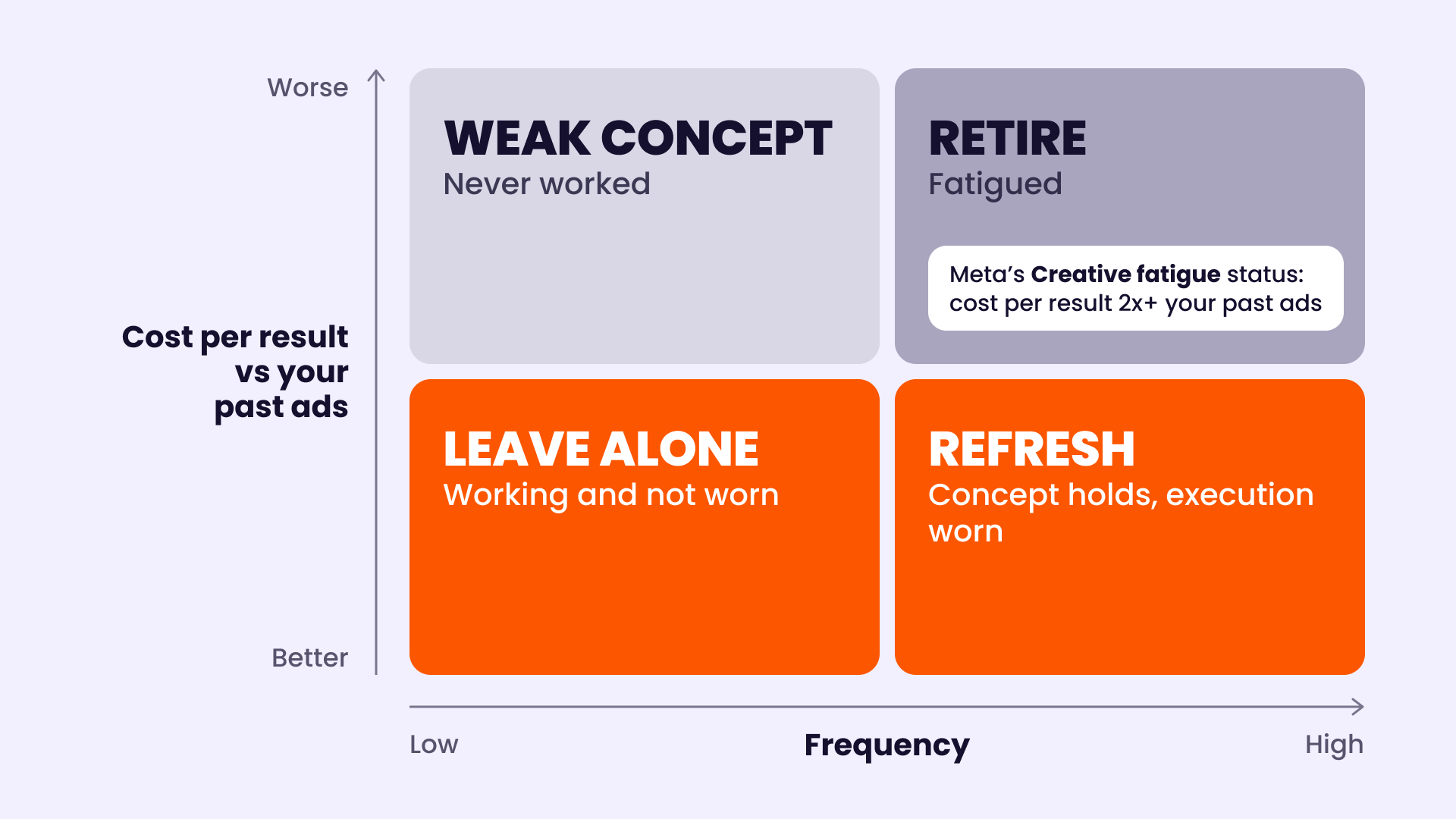
Retire anything where performance has deteriorated while frequency continues to climb. Meta's own labels can help confirm the pattern: "Creative limited" appears when cost per result is higher than your past ads but less than twice as high, and "Creative fatigue" when it reaches twice or more. Both are lagging indicators. By the time the platform is telling you something is fatigued, you've already experienced the performance decline.
Refresh creative that still has a strong cost per result but is approaching your frequency ceiling. The concept may still be doing its job, so you don't necessarily need to abandon it. A new hook, format, creator or execution can give a proven idea another route into the audience.
Leave alone anything that's still performing efficiently and hasn't accumulated meaningful frequency. Creative doesn't become bad because it has been live for a certain number of days. If the audience is still responding, there isn't a performance reason to replace it simply to hit a production target.
This distinction matters because creative volume isn't the goal.
The goal is to keep a healthy supply of concepts entering the account.
That's a very different production brief.
Your Q4 creative plan should keep running after Black Friday
A common mistake is treating the first big production drop as the end of the planning process.
It should be the opposite.
If the season runs for around 10 weeks, your creative system needs to keep producing throughout those 10 weeks. Some concepts will fatigue faster than expected. Some will outperform. Some will work for one persona and not another. Some will give you a useful insight that should shape the next brief.
That's the point of testing.
A practical Q4 timeline might look like this:
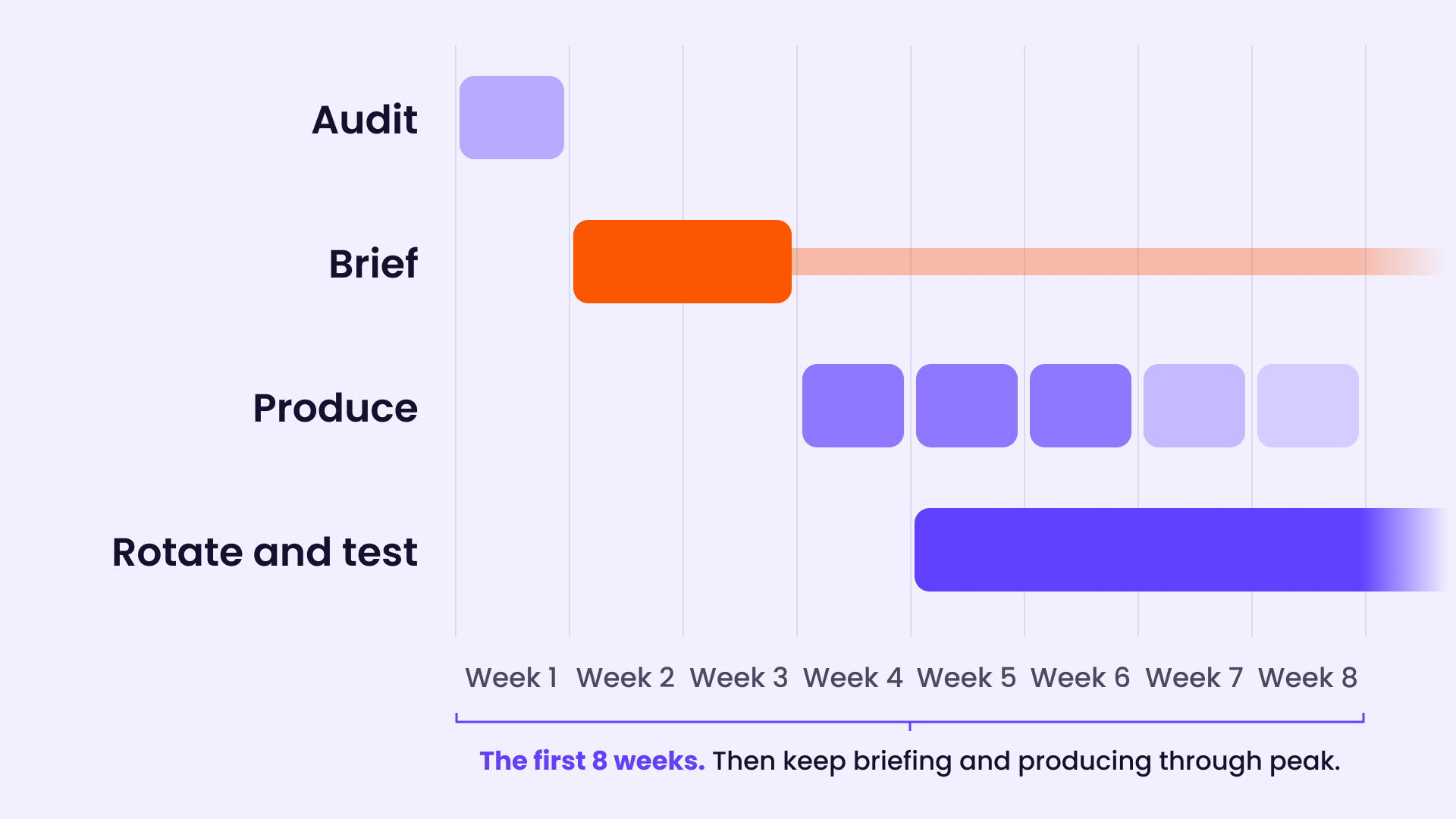
Week 1: Audit the existing account, identify fatigue, confirm your personas and map the key angles across each phase.
Weeks 2–3: Brief the creative for all four phases. Doing this together gives the production team a clearer view of the overall system and creates opportunities to produce efficiently.
Weeks 4–6: Move into production and stagger delivery rather than releasing everything at once. You want a steady flow of new concepts entering the account as the season progresses.
Week 7 onwards: Keep briefing and producing. The account shouldn't run out of new ideas simply because Black Friday has passed.
The number worth fixing before week 4 is your weekly intake rate: how many new concepts need to enter the account each week, rather than how many assets come out of the shoot. Your intake rate will usually need to increase as spend and competition increase, which is why it's useful to establish it before production starts. If you're producing one new concept a week in October, two a week in November may be closer to what the account needs. Working out your own version of that number is covered in How Much Ad Creative Do You Need for Q4?
If that number comes out higher than your team can produce, the answer isn't to hit it with variations of the concepts you already have. It's usually better to run two phases properly than four thinly, because a phase built around one tired concept isn't really giving the account meaningful creative variation anyway.
It's also worth keeping a small reserve of finished concepts. If something fatigues earlier than expected, you can replace it immediately instead of waiting two weeks for production to catch up.
Q4 puts your creative system under pressure
This is the part that compounds.
Peak season puts more pressure on every part of the paid social system. Spend increases. Competition increases. Audience exposure increases. And the cost of getting creative wrong increases with it.
That makes creative testing more important, not less.
The brands best set up for Q4 aren't necessarily the ones with the biggest production budgets. They're the ones with a system that can turn customer insight into new concepts, turn concepts into ads, test those ads quickly, identify what works and feed those learnings back into the next round.
Frequently asked questions
When should Black Friday creative planning start?
Ideally in June or July. That gives you enough time to research your customers, define personas and angles, produce the creative and learn from testing before peak spend arrives.
If you're starting in September, it's not too late, but the priority should shift from broad planning to execution. Lock the persona and angle set, then start producing.
How many ads do you need for Black Friday?
There isn't one number that works for every brand. The right creative volume depends on your media spend, reachable audience and how quickly frequency accumulates.
A better approach is to work backwards from those inputs and calculate how many new concepts your account needs each week. We've covered that in How Much Ad Creative Do You Need for Q4?
Should you build separate campaigns for each phase?
Not necessarily. The creative needs to adapt across the season, but that doesn't mean the account structure needs to change with it.
Keeping the structure relatively simple while introducing meaningful creative variation gives Meta more to work with without repeatedly disrupting campaign learning.
What is the difference between Creative Limited and Creative Fatigue?
Both are defined on cost per result. "Creative limited" appears when your cost per result is higher than your past ads but less than twice as high. "Creative fatigue" appears when it reaches twice or more.
Both are better treated as confirmation than prediction. Your own frequency and cost-per-result trends are more useful for spotting when creative is losing efficiency, because they give you a chance to act before the platform formally labels it.
Is it too late to plan Q4 creative in September?
No, but this is the point where planning needs to become production.
The research and strategic thinking behind the creative can't be compressed indefinitely, so the priority should be locking personas and angles and getting the first briefs into production.
Does creative need to change for January?
Yes. The customer mindset has changed, so the reason to buy needs to change with it.
Gifting becomes less relevant, while value, quality and personal relevance become more important. Carrying December creative directly into January misses that shift.
How Aura can help
That's the role of a Creative Operating System: strategy informs production, production feeds testing, and testing feeds the next round of strategy. Instead of asking one batch of creative to carry the account through Q4, you build a system that keeps producing and learning as the season changes.
That's what we build.
It delivered 1,694 new assets for HelloFresh across 12 months, tested as more than 4,300 ads. For Who Gives A Crap, it produced 375+ concepts at a 21% win rate across three markets, supporting 70% growth in the UK. And for Tonies, it turned Q3 consideration into a 2.5x increase in year-on-year ad spend through peak.
For Q4, the principle is simple: don't build one Black Friday campaign. Build a creative system that can keep learning throughout the season.
Related reading:
- What Creative Diversity Actually Means (And How to Implement It)
- Black Friday Ad Ideas: Angles That Work When Everyone is on sale
- How Much Ad Creative Do You Need for Q4?
We are Aura Ads, a specialist performance creative agency for DTC and eCommerce brands. We help clients sell more online and grow at scale with performance creative delivered at speed.
Sources
- Meta Engineering Blog, "Meta Andromeda: Supercharging Advantage+ automation with the next-gen personalised ads retrieval engine," December 2024. engineering.fb.com
- Meta Business Help Centre, creative fatigue recommendations: "Creative limited" and "Creative fatigue" delivery status definitions.
- Aura Ads, Tonies case study.
- Aura Ads, HelloFresh case study.
- Aura Ads, Who Gives A Crap case study.

Subscribe to our newsletter

More blog posts
See All